


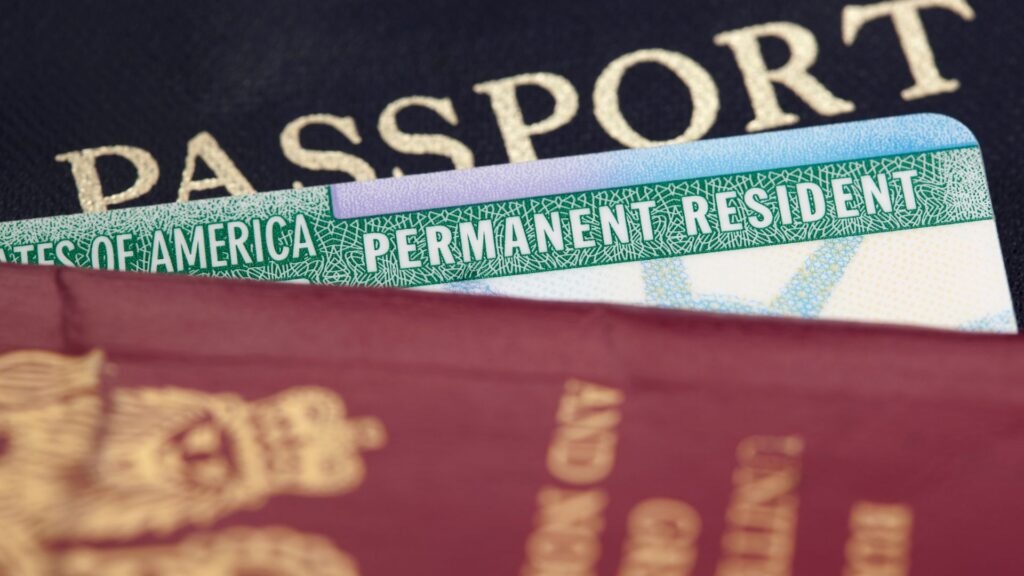












IR6 on a green card means you became a permanent resident as the spouse of a U.S. citizen and received that status through adjustment of status inside the United States. Adjustment of status is the process of applying for a green card without leaving the country. A permanent resident may live and work anywhere in the United States. The code appears in the Category field on the front of your card, next to the number U.S. Citizenship and Immigration Services (USCIS) uses to identify your records.
In the code, IR stands for immediate relative, a group that includes spouses of U.S. citizens. The 6 shows that the status came through adjustment in the United States rather than an immigrant visa issued abroad. IR6 also signals that your marriage was at least two years old when you became a resident, so your permanent residence has no conditions. Faragalla Law helps couples prepare spousal green card cases through its marriage green card practice.
What Is the Difference Between IR6 and IR1 on a Green Card?
The number at the end of the code shows how you got your green card. Immigration statistics from the Department of Homeland Security (DHS) list IR1 as spouses who arrived as new immigrants and IR6 as spouses who adjusted status. An IR1 spouse ordinarily went through consular processing, which means applying for an immigrant visa at a U.S. embassy or consulate abroad and entering the country with it.
The same pattern runs through related codes. A child of a U.S. citizen who adjusts status usually receives IR7. A spouse who entered on a K-1 fiancé(e) visa and then adjusted receives CF1 if the marriage was under two years old at approval, or IF1 if it was older.
Consider a nurse from the Philippines who entered on a work visa, married a U.S. citizen and was approved in Houston three years after the wedding. Her card would ordinarily show IR6. Had she received an immigrant visa abroad instead, it would show IR1.
Does IR6 on a Green Card Mean Your Residence Has Conditions?
No. Conditional residence applies when a marriage-based green card is granted less than two years after the wedding, and those cards carry a CR code instead. A conditional card is valid for two years, and the holder must file Form I-751 to remove the conditions. See how those rules work for the CR6 category and its two-year card.
An IR6 card is not conditional. Green cards generally carry either a 10-year or a two-year expiration date, and the two-year cards go to conditional residents. When an IR6 card expires or will expire within six months, the holder renews it with Form I-90, the Application to Replace Permanent Resident Card. USCIS notes that a person with an expired card may still be a permanent resident, but renewing keeps your proof of status current.
Sometimes a code is simply wrong. Officers may find a spouse coded CR6 even though the marriage was more than two years old at adjustment. The USCIS Policy Manual tells them to update that code to IR6. The Form I-90 instructions tell a misclassified spouse to file under the DHS error reason with a copy of the marriage certificate.
Can Spouses Still Get an IR6 Green Card Through Adjustment of Status in 2026?
Spouses of U.S. citizens can still apply to adjust status, but USCIS now stresses its discretion. On May 21, 2026, USCIS issued Policy Memorandum PM-602-0199. It tells officers that, where consular processing is available, adjustment of status is extraordinary discretionary relief and an act of administrative grace. Discretion means an officer may deny an application even when the applicant meets every eligibility rule.
The memo tells officers to weigh all positive and negative factors. It calls a failure to follow the terms of a visa or parole highly relevant. The same goes for a failure to leave as expected, especially when the person could have used the immigrant visa process abroad. A spouse applying now may therefore face close review of entry history and past visa compliance.
A spouse from Colombia who overstayed a tourist visa before marrying, for example, may need to show significant positive factors, such as strong family ties in the United States. The memo says the absence of negative factors does not, by itself, show the unusual or outstanding equities, meaning strong positive factors, that such a case may need.
Official Government Sources on the IR6 Category
The DHS Office of Homeland Security Statistics lists every immigrant class of admission code, including IR1, IR6, CR1 and CR6. Chapter 2 of USCIS Policy Manual Volume 6, Part I explains conditional residence and how officers correct a CR6 code that should have been IR6.
USCIS explains its current approach to discretion in Policy Memorandum PM-602-0199, dated May 21, 2026.
Speak With a Texas Immigration Lawyer About Your IR6 Card
Do you have questions about IR6 on a green card, or think your category code is wrong? Faragalla Law can review your card and your case history.
Couples from Houston to Lubbock can talk with the firm remotely about spousal green cards. Reach the firm at (800) 707-3038 to arrange a free consultation.
You can also send Faragalla Law a message that lists the category code and Resident Since date printed on your card.