


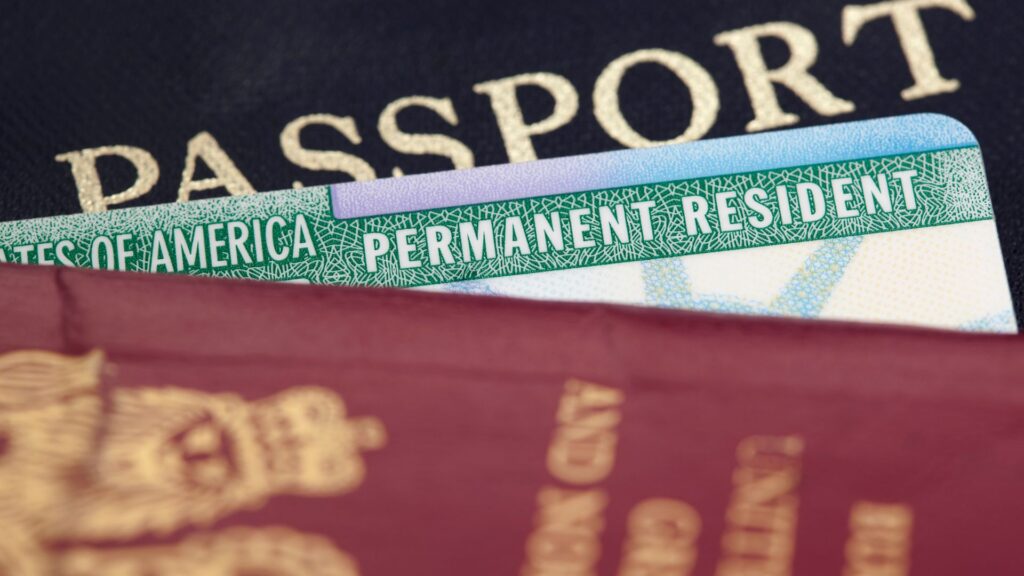








Permanent residence ends at death and never passes to relatives. That is what happens to a green card when the holder passes away, because the status belongs only to the person who held it. Federal law describes that status as the privilege of residing permanently in the United States, and it does not transfer to a spouse, child or heir.
Relatives who already hold their own green cards generally keep them, since each person’s status stands on its own. The harder questions involve relatives who were still waiting. A death can cancel a family petition that the deceased person filed, but federal law protects some surviving relatives. Faragalla Law reviews these situations through its I-130 petition practice.
What Happens to Pending Petitions for a Green Card When the Holder Passes Away?
Federal regulations automatically revoke an approved family petition when the petitioner dies. On its own, that rule would end a case a permanent resident filed for a spouse or child. Section 204(l) of the Immigration and Nationality Act creates an exception for relatives who lived in the United States when the petitioner died and who still live here.
Under that section, USCIS can keep processing the petition and a related application to adjust status. Adjustment of status lets a person become a permanent resident from inside the United States. The protection covers beneficiaries, meaning the relatives named in pending or approved family petitions. It also covers derivatives, the spouses and children included on family and employment petitions, and certain asylee and refugee relatives. USCIS can still deny a case if it decides approval would not serve the public interest.
For example, a permanent resident in Fort Worth might file a petition for her unmarried adult son, who lives with her while attending a local college. If she dies before his case finishes, 204(l) may let USCIS continue it because he lived in the United States at her death. He would usually need a substitute sponsor, such as a sibling or grandparent. That person signs Form I-864, the affidavit of support, in her place.
Relatives abroad who do not meet the 204(l) residence rule have a narrower option called humanitarian reinstatement. It applies only to a petition USCIS approved before the petitioner died. The principal beneficiary must ask for it and show that a qualifying relative will act as substitute sponsor. USCIS then decides as a matter of discretion.
What if a U.S. Citizen Spouse Dies Before the Green Card Is Approved?
The rules differ when the person who died was a U.S. citizen rather than a green card holder. A widow or widower of a citizen can still seek a green card as an immediate relative. That category covers a citizen’s spouse without a visa backlog.
The surviving spouse must file Form I-360 within two years of the death, and the couple must not have legally separated before the death. This path ends if the surviving spouse remarries. A surviving spouse can include children under 21.
Sometimes the citizen already filed an I-130 for the spouse. USCIS then treats that petition as a widow or widower petition if the spouse meets the requirements, so no new filing is necessary. For example, a man from the Philippines who married a U.S. citizen in Austin could continue his pending case this way after her death. He must not have remarried.
What Happens to a Conditional Green Card When the Spouse Dies?
Some spouses hold a conditional green card, which requires a second filing to become permanent. Normally the conditional resident and the spouse file Form I-751 together. They file in the 90 days before the second anniversary of the date the resident got that status. For background on conditional codes, see the firm’s explanation of what category CR6 means on a green card.
If the petitioning spouse dies, federal rules let the conditional resident apply for a waiver of the joint filing requirement and file alone. A child who got conditional status with the parent can join the parent’s filing. When the parent’s death keeps a child from joining a joint filing, the child may file a separate Form I-751.
Official Sources on Green Card Cases After a Death
The USCIS Policy Manual chapter on the death of a petitioner or principal beneficiary explains 204(l), the residence rule and substitute sponsors. The federal regulation at 8 CFR 205.1 sets out automatic revocation and humanitarian reinstatement.
Federal regulation 8 CFR 204.2 contains the widow and widower conversion rule, and 8 CFR 216.4 contains the conditional residence waiver.
Sort Out Pending Cases After a Death in the Family With Faragalla Law in Houston
When a green card holder passes away, relatives often learn about filing windows only after one has started to run. Faragalla Law can gather the receipt notices, approval notices and death certificate and tell you which survivor protections may still be open.
Families can arrange a free consultation by phone at (800) 707-3038.
If a call feels like too much right now, leave the firm a written note listing the forms your family filed and their dates.